Jim Fanthorp
Death on the NileJim Fanthorp is a young lawyer sent to Egypt on a confidential assignment concerning Linnet Doyle and Andrew Pennington. Initially mistaken for a passenger travelling for pleasure, he proves valuable not through conspicuous authority but through watchfulness: he listens closely, notices what others overlook, and later supplies evidence about the events surrounding Simon Doyle’s shooting. His part in the investigation also brings a practical tension into view: suspicion may be well founded, but suspicion alone is not proof.
Identity and Assignment
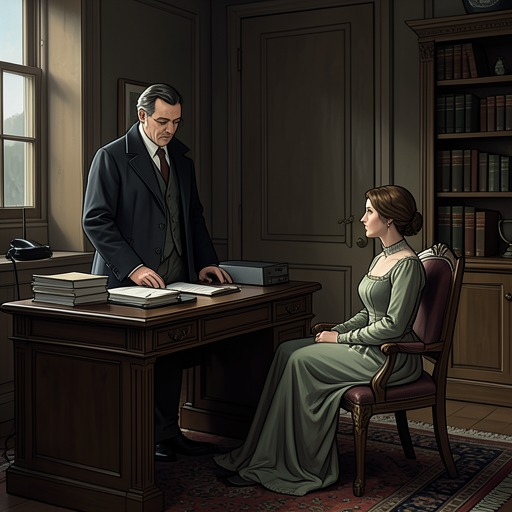
Jim is William Carmichael’s nephew and a lawyer. Before he goes to Egypt, William Carmichael calls him in and tells him that Linnet Ridgeway and Andrew Pennington have not met him. He considers this an advantage: Jim can observe them without announcing the connection. William Carmichael instructs him to use his eyes and ears, think for himself, and act if necessary. He calls the matter vital and urges him to leave without delay, suggesting that he travel by air in the hope of arriving in time.
Jim is uneasy about the assignment and asks what he is supposed to do. William Carmichael does not give him a specific course of action; instead, he insists on the need for alertness and judgment. The exchange establishes the character of Jim’s task as discreet observation rather than a clearly defined intervention. It also sets up his later conduct: he remains reserved, but his attention is active and directed toward what people say and do.
The information that prompts the journey comes from a letter describing Linnet’s accidental-seeming encounter with her American trustee at Cook’s ticket office. She writes that neither she nor Andrew Pennington knew the other was in Egypt, and that he will be travelling up the Nile on the same trip as she and Simon Doyle. William Carmichael and Jim reject coincidence as a sufficient explanation. Jim recognizes that the meeting warrants investigation, though the available account does not specify everything William Carmichael suspects or what Jim is expected to discover.
Observation Aboard the Karnak
Aboard the Karnak, Jim is known as the quiet young passenger who does not talk at the same table as a German passenger. Mrs. Allerton notices his cautious but intelligent appearance. Hercule Poirot likewise observes that Jim speaks little but listens attentively and watches those around him. Poirot regards him as an unusual traveller in that part of the world and wonders what has brought him there. The contrast between Jim’s silence and the deliberate attention behind it reflects the nature of his assignment: he gathers impressions without making himself a conspicuous centre of attention.
That reserve briefly gives way when Simon Doyle speaks lightly of signing documents without reading them. Andrew Pennington responds that this habit may be risky. Jim then turns to Linnet and, with evident embarrassment, praises her businesslike care in reading documents before signing. The intervention is awkwardly formal enough to make Linnet suppress a giggle, and Andrew Pennington appears seriously annoyed. Yet the remark has a clear practical point: Jim supports the very caution that Simon’s easygoing attitude dismisses. His professional knowledge gives him reason to recognize the importance of documents, while the moment also signals that he is monitoring the business relationships around Linnet.
Witness to the Shooting and Its Aftermath
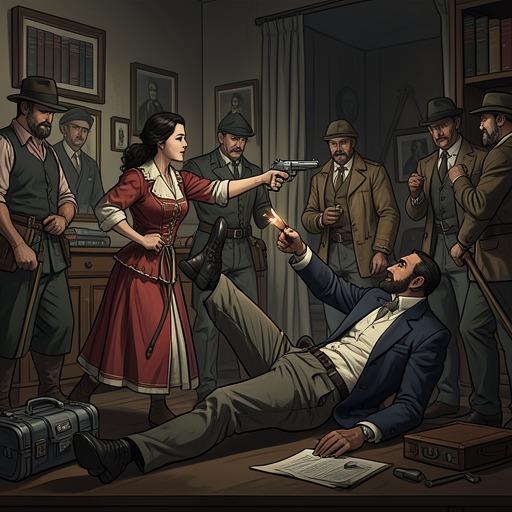
Jim becomes a witness to the disturbance in which Jacqueline de Bellefort shoots Simon Doyle. In Hercule Poirot’s later reconstruction, Cornelia Robson and Jim provide evidence that Simon Doyle remained in the saloon until the quarrel began. Jim heard the shot and then found Simon with a red-stained handkerchief pressed to his leg. He also saw Simon insist that Jacqueline de Bellefort should not be left alone and suggest that Jim fetch the doctor. Jim and Cornelia Robson accompany Jacqueline de Bellefort away, keeping them occupied on the port side of the deck for the next five minutes.
These details later matter because they seem to support the apparent account of Simon Doyle’s injury and place him among the people who can speak to the sequence of events. Poirot uses Jim’s evidence, alongside Cornelia Robson’s and the medical testimony of Dr. Bessner and Miss Bowers, when testing whether Simon could have left the saloon and whether his injury prevented him from acting afterward. The testimony appears to make Simon’s movements certain. Poirot eventually identifies a gap between the initial observations and the later medical evidence, and explains that the apparent certainty of what witnesses saw did not establish everything that had happened during that interval. Jim’s testimony is thus significant both for what it establishes and for the limits of what it can establish.
Evidence, Suspicion, and the Investigation
Jim is not simply an observer who accepts a detective’s conclusion. When Hercule Poirot proposes that Simon Doyle’s trusting attitude toward business and Linnet Doyle’s greater care could point toward a motive, Jim objects that the argument is conjecture, not evidence. Poirot answers that evidence will be obtained, but Jim’s objection preserves an important distinction between a plausible explanation and a demonstrated case. His legal training and cautious temperament make him attentive to that distinction even while his own observations help shape the investigation.
Hercule Poirot later appeals directly to Jim’s professional responsibilities. He points out that the murder of Salome Otterbourne followed two other murders aboard the Karnak, and that the weapon used to kill her was a revolver owned by Andrew Pennington. He argues that this makes it Jim’s duty to disclose what he knows. Jim remains silent for several minutes before explaining that he has no exact information to offer. The exchange shows both his reluctance to overstate his knowledge and the pressure created when observation intersects with a lawyer’s sense of responsibility.
At another point, Hercule Poirot presses the legal implications of the murders and the scrutiny that would follow of Linnet Doyle’s estate. The man he confronts visibly sags, and the narration confirms that Jim’s suspicions were well founded. The episode gives his earlier assignment a consequence beyond merely watching: his concern about the people and business circumstances around Linnet is borne out, even though the available evidence does not specify every detail of his suspicions.
Narrative Role and Significance
Jim’s contribution is made up of small, concrete acts: he recognizes that the meeting in Egypt is unlikely to be a coincidence, accepts an assignment despite misgivings, listens and watches aboard the Karnak, challenges Simon Doyle’s carelessness about legal documents, and provides an account of the shooting and its immediate aftermath. None of these actions alone solves the case. Together, they place him at crucial points in the chain of inference, where the distinction between appearance, recollection, and proof becomes decisive.
His role also gives the investigation a useful counterweight to Hercule Poirot’s confidence in reconstruction. Jim does not deny that a theory may be persuasive; he insists that persuasion is not the same as evidence. Poirot himself later has to abandon an initial conception of the crime and reconsider facts that do not fit it. Jim’s insistence on evidentiary limits therefore accords with the mystery’s eventual method: observations matter, but they must be tested against one another, and an apparently complete account may still conceal a gap.